Understanding Basketball’s Five Positions: A Simple Guide
Whether you’re watching an NBA game or shooting hoops at the local gym, the way a team arranges its players on the court matters. The lineup is built around five distinct roles—often labeled as basketball positions 1 to 5—that each bring a mix of skills, size, and strategy. Below we break down those spots in plain language, so you can spot the differences the next time you hear a coach call out “play the point” or “set a screen.”
Basketball Positions 1 to 5: What They Mean
In the most traditional system, the numbers correspond to specific spots on the floor:
- 1 – Point Guard
- 2 – Shooting Guard
- 3 – Small Forward
- 4 – Power Forward
- 5 – Center
Modern basketball blurs the lines, but those five labels still give you a useful shorthand for a player’s primary responsibilities.
1️⃣ Point Guard – The Floor General
The point guard is the team’s chief orchestrator. Usually the smallest player on the roster, they excel at ball handling, vision, and decision‑making. Their job is to bring the ball up the court, read the defense, and either drive to the basket or deliver a precise pass. Think of the point guard as a chess player: one move ahead, constantly setting up teammates for success.
Key attributes include quick hands, a high basketball IQ, and the poise to control the game’s tempo. Defensively, they pressure the opposing ball‑handler, looking to force turnovers that can swing momentum.
2️⃣ Shooting Guard – The Scorer on the Wing
The shooting guard, often called the “off‑guard,” blends scoring ability with secondary playmaking. They’re typically comfortable shooting from distance, cutting to the basket, and creating their own shot when the defense collapses.
Ideal shooting guards have a reliable three‑point shot, an agile first step, and the knack for reading when to attack versus when to swing the ball back to the point guard. On defense, they often guard the opponent’s best perimeter scorer, demanding both length and quickness.
3️⃣ Small Forward – The Versatile Swingman
Small forwards are the Swiss‑army knives of a lineup. They must be able to score from inside and out, rebound, and guard multiple positions. Because they sit between the backcourt and the frontcourt, they frequently act as a bridge, facilitating ball movement while also finishing plays.
A successful small forward combines athleticism with a solid mid‑range game and an ability to finish strong at the rim. Defensively, they switch onto larger forwards or quicker guards, making them essential in today’s position‑less schemes.
4️⃣ Power Forward – The Physical Inside Presence
Power forwards bring strength to the paint without necessarily being as tall as a traditional center. They battle for rebounds, set screens, and often have a reliable mid‑range jumper that stretches the defense.
Modern power forwards are also expected to handle the ball in pick‑and‑roll situations and occasionally step out for three‑point attempts, adding a “stretch‑four” dimension that forces opponents to defend farther from the rim.
5️⃣ Center – The Anchor of the Defense
The center anchors the interior on both ends of the floor. Their primary duties are protecting the rim, controlling the glass, and providing a low‑post scoring option. Height, wingspan, and timing are the hallmarks of an effective center.
While classic centers dominate with post moves and shot‑blocking, many now possess a soft‑touch hook shot and can step out for occasional mid‑range looks. On defense, they serve as the last line, altering shots and directing the team’s defensive positioning.
How the Positions Interact on the Court
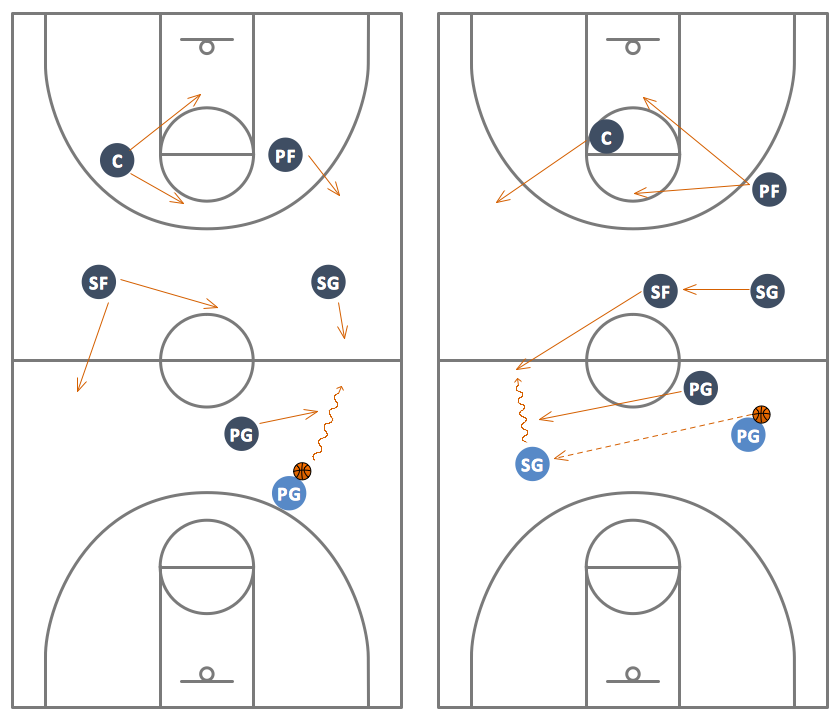
Even though each role has its own focus, basketball is a fluid sport. A point guard might cut to the basket, a forward could bring the ball up the floor, and a center may step out to the three‑point line in certain offensive sets. The best teams understand how to exploit mismatches—like posting a quick guard against a slower big man or using a stretch‑four to open driving lanes.
Coaches often design plays that start with the point guard initiating a pick‑and‑roll with the center, then hand the ball off to a wing for a catch‑and‑shoot opportunity. The synergy among the five positions creates space, forces defensive rotations, and ultimately yields higher‑percentage shots.
Frequently Asked Questions
What’s the difference between a “shooting guard” and a “small forward”?
A shooting guard primarily focuses on perimeter scoring and defending the opponent’s best wing player. A small forward, meanwhile, is expected to contribute across the board—scoring inside and out, rebounding, and defending multiple positions.
Can a player switch positions during a game?
Absolutely. Coaches often shuffle lineups to exploit mismatches or rest teammates. For example, a versatile forward might start as a small forward but slide into the power forward spot when the center rests.
Do all teams still use the traditional 1‑5 numbering?
Most professional teams retain the numbering as a shorthand, but many run “positionless” lineups where players fluidly take on multiple roles. Still, the five‑position framework remains a helpful reference for players and fans alike.
How important is height for each position?
Height matters most at center and power forward, where interior play dominates. Point guards and shooting guards can succeed at a wide range of heights, provided they have the requisite skill set and athleticism.