How to Troubleshoot and Boost a TEA2025 Amplifier Circuit
Typical Symptoms and Their Likelihood
When a TEA2025 amplifier circuit misbehaves, the first clue is often the sound itself. A whining whine, sudden silence, or intermittent crackle can all point to different culprits. If the output is unusually low, the gain stage may be starving for voltage. A persistent high‑frequency squeal usually means the feedback network is unstable. And when the chip overheats quickly, you’re probably looking at inadequate power‑supply decoupling.
These symptoms aren’t exclusive to the TEA2025, but the chip’s low‑power design makes them especially noticeable. Before you dive into the schematic, write down exactly what you hear and when it happens – that short notebook can save hours of guesswork.
Step‑by‑Step Diagnosis
1. Visual Inspection
- Check for cracked solder joints, especially around the input pins and the ground plane.
- Look for any discoloration on the TEA2025 package; a brown tip often signals overheating.
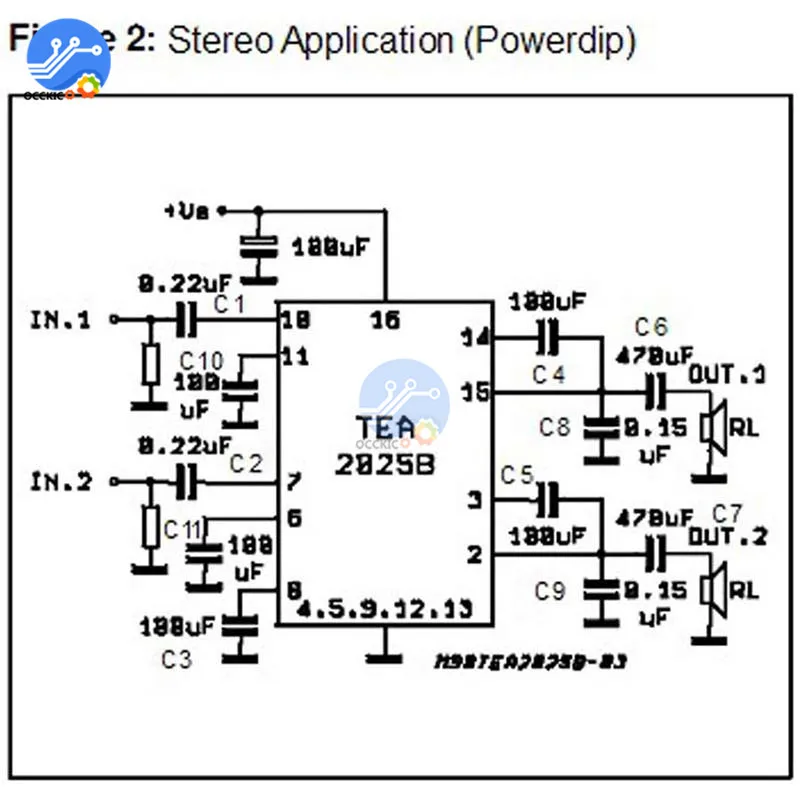
- Verify that all capacitors match the schematic values – a 10 µF capacitor swapped for a 0.1 µF can cripple the bias network.
2. Power‑Rail Verification
Power the circuit and measure the supply voltage at the VCC pin with a multimeter. The TEA2025 typically runs from 5 V to 15 V; anything outside this range will shift the internal bias and reduce headroom. If you see ripple exceeding 50 mV on an oscilloscope, add a 100 µF electrolytic and a 0.1 µF ceramic in parallel close to the chip.
3. Input Signal Check
Feed a known 1 kHz sine wave into the input and monitor the output with an oscilloscope. The waveform should be a clean amplified replica, not clipped or distorted. If the output appears flattened at the peaks, the gain resistor may be too large, or the chip is hitting its current limit.
4. Feedback Loop Evaluation
Measure the voltage across the feedback resistor and the resistor to ground. The ratio sets the gain; a deviation of more than 5 % from the design value suggests a damaged resistor or a solder bridge. In some cases, the feedback network can pick up stray capacitance, leading to oscillation. Adding a small (10–20 pF) capacitor across the feedback resistor can dampen that.
5. Thermal Check
Touch the TEA2025 after a few minutes of operation – it should be warm, not scorching. If it feels hot, consider adding a tiny heatsink or improving airflow. Excessive heat often correlates with an undersized supply capacitor or a shorted output stage.
Improving Performance Without Redesigning
Once the circuit runs cleanly, you can still squeeze out more headroom and lower distortion. Here are a few low‑effort upgrades:
- Upgrade the coupling caps. Replacing 0.1 µF film caps with 1 µF low‑ESR electrolytics reduces low‑frequency roll‑off.
- Add a bypass capacitor. A 0.01 µF ceramic from the VCC pin to ground filters high‑frequency noise that can modulate the gain.
- Fine‑tune the gain resistor. Swapping a 10 kΩ resistor for 9.1 kΩ drops the gain by about 1 dB, often enough to eliminate audible clipping in a loudspeaker setup.
- Implement a simple output filter. A series 100 Ω resistor followed by a 10 µF electrolytic across the speaker terminals smooths out any residual high‑frequency spikes.
These tweaks keep the original layout intact while delivering a cleaner, louder sound. They’re especially useful if you’re powering the circuit from a battery pack, where voltage sag can otherwise limit performance.
Power Supply Best Practices
A stable power source is the backbone of any audio amplifier. For the TEA2025, a regulated DC supply with less than 1 % ripple is ideal. If you’re using a linear regulator, add a 0.33 µF ceramic on the input and a 10 µF electrolytic on the output. For a switching regulator, place an LC filter close to the chip to tame high‑frequency switching noise.
Don’t overlook the ground layout. A single, wide ground plane beneath the TEA2025 minimizes ground‑loop inductance. Keep high‑current traces (like the speaker output) away from low‑level signal paths to avoid crosstalk.
Protective Measures and Longevity
Even a modest amp can be damaged by a sudden voltage spike. Adding a pair of TVS (transient voltage suppression) diodes across the supply rails protects against accidental short circuits or power‑on transients. Similarly, a 100 µF electrolytic on the input side can act as a soft limiter for unexpectedly loud signals.
Finally, consider a gentle power‑on sequence. A brief delay (a few milliseconds) after applying VCC before feeding the audio signal gives the internal bias network time to settle, reducing the chance of pop noises that can stress the output stage.
FAQ
Q: Why does my TEA2025 amplifier emit a high‑pitched squeal?
A: The squeal is usually a sign of feedback instability. Check the feedback resistor for correct value, add a small bypass capacitor (10–20 pF) across it, and ensure the power supply is well‑decoupled.
Q: Can I run a TEA2025 from a 12 V car battery?
A: Yes, the chip tolerates up to 15 V. However, you’ll need a low‑noise regulator to drop the battery voltage to a stable level and a sufficient bulk capacitor (≥100 µF) to handle the car’s voltage ripple.
Q: My output volume is low even though the gain resistor is correct. What should I check?
A: Verify the supply voltage at the VCC pin, inspect the coupling capacitors for correct polarity, and make sure the speaker load matches the design (typically 8 Ω). A mismatched load can cause the TEA2025 to hit its current limit early.
Q: Is it safe to add a heatsink to the TEA2025?
A: The TEA2025 dissipates only a few hundred milliwatts, so a large heatsink isn’t necessary. A tiny metal clip or a small aluminum pad can improve thermal spreading if the chip runs hot under continuous load.




.jpg)