How to Fill Out a Power of Attorney: A Simple Guide
What a Power of Attorney Actually Does
A power of attorney (POA) is a legal document that lets you name another person—called an agent or attorney‑in‑fact—to act on your behalf in financial, medical, or legal matters. The authority can be broad, covering everything from paying bills to signing contracts, or it can be limited to a single transaction, such as selling a property. Understanding the scope of the POA you need is the first step toward completing the paperwork correctly.
Choosing the Right Type for Your Situation
Not all POAs are created equal. Here are the most common varieties:
- General Power of Attorney – grants sweeping authority while you’re capable of overseeing decisions.
- Durable Power of Attorney – remains effective if you become incapacitated, making it the go‑to for long‑term planning.
- Limited (or Special) Power of Attorney – restricts the agent’s power to a specific task or time frame.
- Medical (Health Care) Power of Attorney – authorizes the agent to make health‑care choices when you can’t.
Pick the form that matches your goals; the language on the document will differ slightly depending on the type you select.
Step‑by‑Step: Filling Out the Form
Most states provide a standardized POA form, but the core sections are similar everywhere. Follow these steps to avoid common pitfalls:
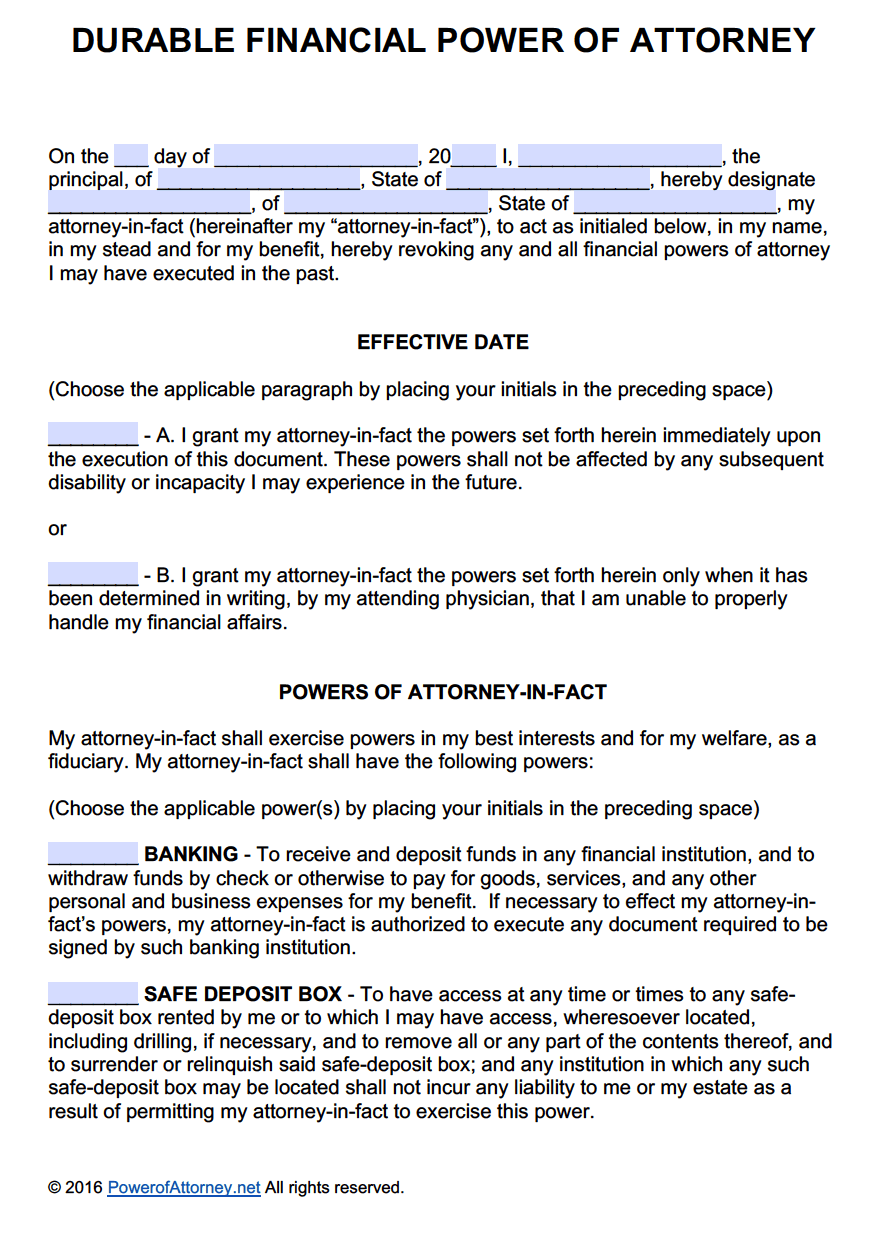
- Identify the principal and agent. Write your full legal name as the principal and include the agent’s name, address, and relationship to you. Double‑check spelling—mistakes can render the POA invalid.
- Specify the powers granted. Use checkboxes or a brief paragraph to outline exactly what the agent can do. For a durable POA, add the clause “this authority shall continue despite my subsequent incapacity.”
- Set the effective date. Decide whether the POA starts immediately or only upon a triggering event, such as a physician’s certification of incapacity.
- Include any limitations. If you want to restrict the agent from selling real estate, for example, list that limitation clearly.
- Sign and date the document. Your signature must be placed in the presence of a notary public (and sometimes witnesses, depending on state law). The agent does not sign the form—only the principal does.
- Notarize and distribute. After notarization, give a copy to the agent, keep one for your records, and consider filing a copy with your bank or health‑care provider if the POA relates to those institutions.
Common Mistakes to Avoid
Even a well‑intentioned person can trip over the details. Keep an eye out for these frequent errors:
- Leaving blanks—unfilled sections can be interpreted as an incomplete document.
- Using vague language—phrases like “manage my affairs” may be too broad for a limited POA.
- Skipping notarization—most jurisdictions require a notary to validate the principal’s signature.
- Choosing an unsuitable agent—select someone you trust implicitly and who is capable of handling the responsibilities.
- Failing to update the POA after major life changes, such as divorce or relocation.
When to Seek Professional Help
If your situation involves complex assets, multiple agents, or cross‑state considerations, a lawyer can tailor the language to protect you from unintended liabilities. Likewise, when the POA will be used for health‑care decisions, an attorney can ensure the document complies with state-specific medical consent statutes.
Even a brief consultation can clarify whether a standard form suffices or if a custom draft is warranted. The cost of professional advice is often far less than the expense of correcting a faulty POA later on.
Frequently Asked Questions
- Can I revoke a power of attorney? Yes. As long as you are mentally competent, you can revoke the POA in writing, notify the agent, and destroy all copies.
- Do I need a separate POA for each state I own property in? Usually not. A properly executed durable POA is recognized across states, but some banks prefer a state‑specific form.
- What happens if the agent refuses to act? If the agent neglects duties or acts against your interests, you can petition a court to remove them and appoint a new agent.
- Is a power of attorney the same as a will? No. A POA governs decisions while you’re alive, whereas a will controls the distribution of your estate after death.