How to Convert Angles to Radians: A Step‑by‑Step Guide
Whether you’re tackling trigonometry homework or programming a physics engine, converting angles to radians is a skill that pops up far more often than you might think. Radians tie angular measurement directly to the geometry of circles, making calculus, wave analysis, and many engineering formulas feel far more natural. This guide walks you through the why, the how, and a few shortcuts that keep you from getting stuck on the unit‑conversion side of things.
Why Radians Matter in Math and Science
In everyday life we measure angles in degrees—think of a pizza cut into eight slices, each a 45° wedge. Radians, on the other hand, describe an angle as the length of the arc it sweeps on a unit circle. Because the radius of that circle is 1, the arc length equals the angle itself. This one‑to‑one relationship eliminates the extra “‑180/π” factor that shows up in derivative and integral formulas, letting you write sin x and cos x without constantly converting back and forth.
That’s why physics textbooks, computer‑graphics libraries, and calculus courses all default to radians. If you ever need to differentiate sin θ or calculate angular velocity, you’ll be glad you made the switch.
The Formula Behind Converting Angles to Radians
The conversion rests on a simple proportion: one full circle equals 360° or 2π radians. From that, the basic formula emerges:
Radians = Degrees × (π ÷ 180)
In words, you multiply the degree measure by π and then divide by 180. The factor π⁄180 is approximately 0.0174533, which you can keep in mind for quick mental math.
Step‑by‑Step Conversion Process
- Step 1: Identify the degree value. Write down the angle you need to convert, for example 120°.
- Step 2: Apply the factor π⁄180. Multiply 120 by π, then divide the product by 180.
- Step 3: Simplify if possible. 120 × π ÷ 180 reduces to 2π⁄3, which is the exact radian measure.
- Step 4: Check your work. A quick sanity check: 2π⁄3 ≈ 2.094 rad, and 2.094 rad × 180⁄π ≈ 120°, confirming the conversion.
When the degree value isn’t a clean multiple of 30, you can still leave the answer as a fraction of π or round to a few decimal places, depending on the precision your task demands.
Common Pitfalls to Watch Out For
- Forgetting to include π in the final answer, resulting in a plain number instead of a radian measure.
- Mixing up the direction of the conversion; the reverse (radians → degrees) uses the factor 180⁄π.
- Rounding too early. Keep π symbolic until the last step if you need an exact result.
- Applying the formula to angles already expressed in radians—this double‑conversion produces nonsense.
Using Technology: Calculators and Software
Most scientific calculators have a dedicated “π” button and a mode selector for degrees or radians. Set the mode to “DEG” when entering the original angle, then multiply by π⁄180 or use the built‑in conversion key if your device offers one. In spreadsheet programs like Excel, the function RADIANS(degree) does the work instantly.
Programming languages follow the same logic: Python’s math.radians(), JavaScript’s angle * Math.PI / 180, or MATLAB’s deg2rad() all convert under the hood. Knowing the underlying formula helps you debug when a library call returns unexpected results.
Beyond the Basics: Converting Back to Degrees
When the need arises to go the other way, simply flip the conversion factor:
Degrees = Radians × (180 ÷ π)
For instance, 1.5 rad × 180⁄π ≈ 85.94°, so a radian measure of 1.5 corresponds to just under a 90° angle. The same step‑by‑step approach—multiply, then divide—keeps the process transparent.
Quick Reference List
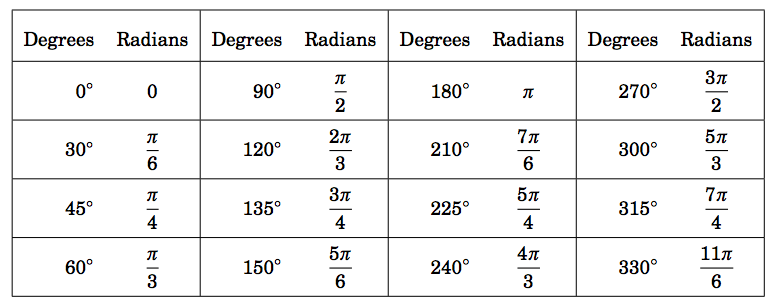
- 0° = 0 rad
- 30° = π⁄6 rad ≈ 0.524 rad
- 45° = π⁄4 rad ≈ 0.785 rad
- 60° = π⁄3 rad ≈ 1.047 rad
- 90° = π⁄2 rad ≈ 1.571 rad
- 180° = π rad ≈ 3.142 rad
- 270° = 3π⁄2 rad ≈ 4.712 rad
- 360° = 2π rad ≈ 6.283 rad
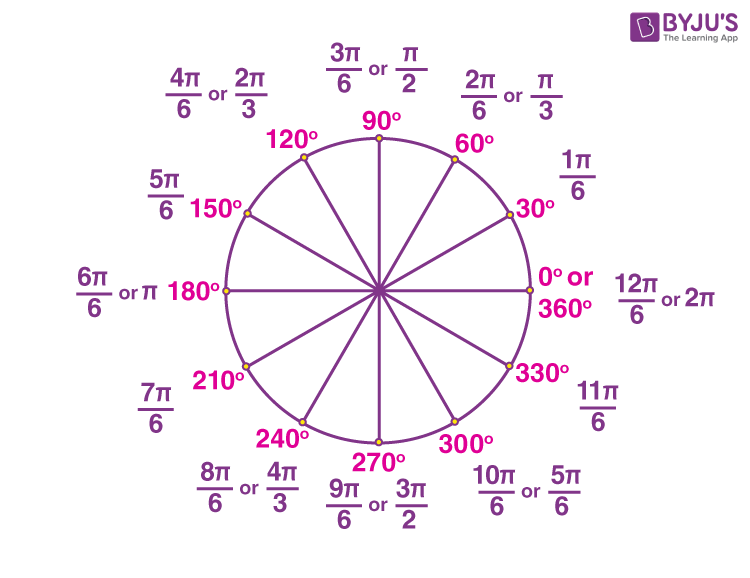
Keeping this list handy can save you a few seconds when you’re sketching a unit circle or checking a trigonometric identity.
FAQ
Q: Do I need a calculator to convert angles to radians?
A: No, the formula is straightforward enough for mental math when the degree measure is a multiple of 30 or 45. For less tidy numbers, a calculator or a simple spreadsheet function speeds things up.
Q: Why do some textbooks write angles in “radians” without the π symbol?
A: In many contexts—especially engineering—people use decimal approximations (e.g., 1.57 rad for π⁄2) to match the precision of other measurements. The exact form with π is preferred in pure mathematics because it preserves symbolic clarity.
Q: Can negative angles be converted the same way?
A: Absolutely. A negative degree value simply yields a negative radian measure, indicating clockwise rotation on the unit circle.
Q: Is there a shortcut for converting 180° increments?
A: Yes. Every 180° equals π rad, so you can add or subtract π for each half‑turn. For example, 540° = 3 × 180° = 3π rad.