Gupta Empire Rulers: Chronological Guide to Ancient India
The Gupta Empire, often hailed as India’s Golden Age, produced a line of monarchs whose reigns shaped art, science, and politics for centuries. If you’ve ever wondered how the dynasty unfolded from its modest beginnings to its dramatic decline, this guide walks you through each ruler in the order they held the throne, highlighting the milestones that made their reigns memorable.
Why a Chronological Look at Gupta Dynasty Rulers Matters
Understanding the Gupta Dynasty rulers in sequence lets you see patterns—how early conquests set the stage for later cultural flourishing, and how internal challenges eventually eroded the empire’s stability. It also helps differentiate the legendary achievements of Samudragupta from the defensive struggles of Skandagupta, which are often lumped together in broader overviews.
Early Foundations and the First Gupta Dynasty Rulers
Most historians agree that the dynasty rose from the modest kingdom of Magadha in present‑day Bihar. The earliest identifiable sovereign is Ghatotkacha, a semi‑mythical figure mentioned in later inscriptions. While concrete dates elude us, he likely ruled in the early 3rd century CE, laying the groundwork for his son, Chandragupta I.
Chandragupta I (c. 320–335 CE)
Chandragupta I transformed a regional power into a formidable kingdom by marrying the Lichchhavi princess Kumaradevi. This alliance brought valuable territories in the north and a boost in prestige, prompting the inscription at Allahabad Pillar to describe him as “Maharajadhiraja” – a great king of kings.
Samudragupta (c. 335–380 CE)
Often called the “Napoleon of India,” Samudragupta’s military campaigns are legendary. The Allahabad inscription lists over 60 defeated kingdoms, ranging from Gujarat to the Deccan. Yet his reign was not purely martial; he patronized poets like Kalidasa and supported Buddhist monastic centers, demonstrating a rare blend of conquest and culture.
Chandragupta II (c. 380–415 CE)
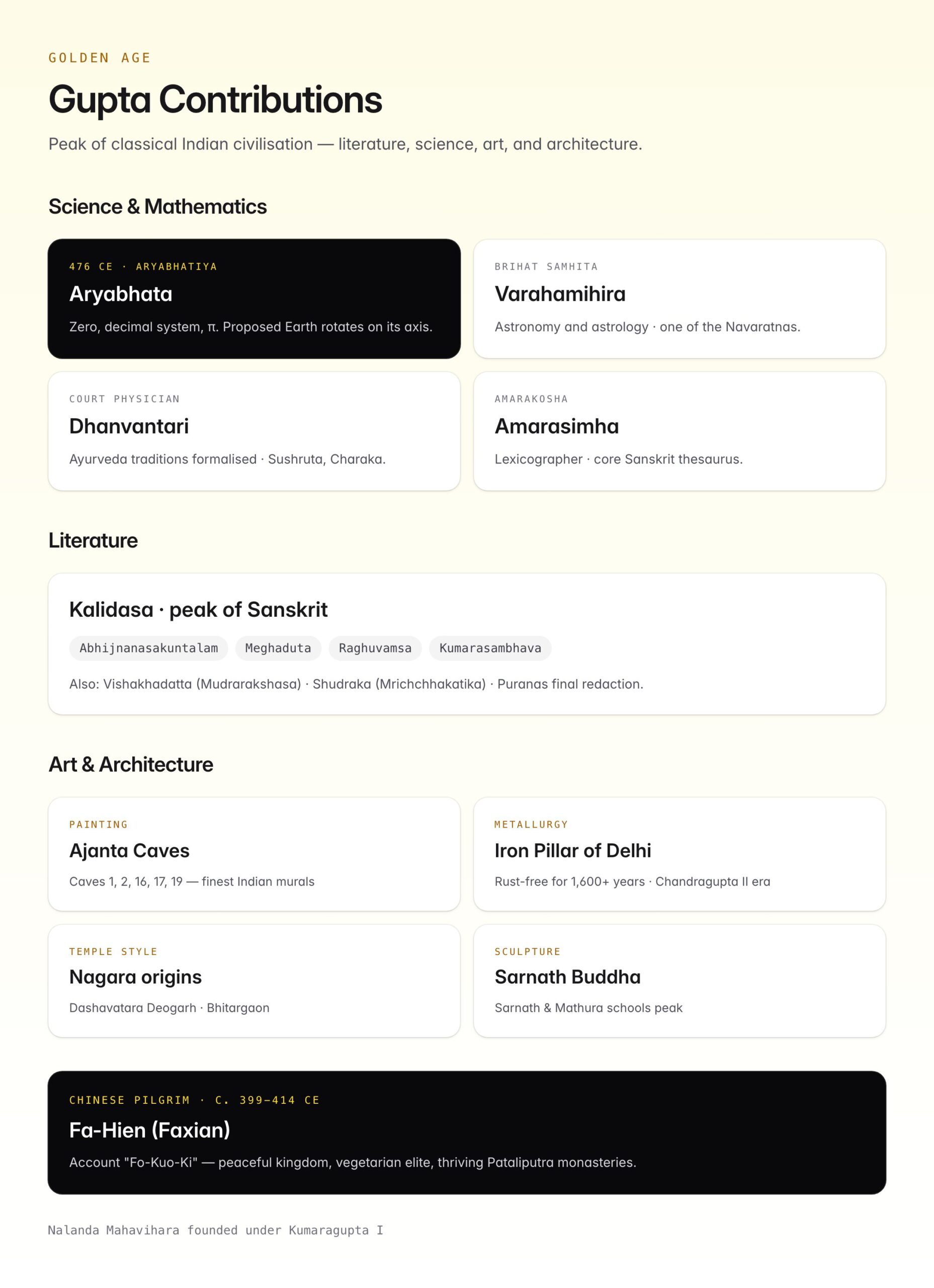
Also known as Vikramaditya, Chandragupta II presided over the empire’s artistic zenith. Under his rule, the famous Udayagiri and Ajanta caves received royal attention, and scholars such as Varāhamihira compiled astronomical treatises that traveled far beyond India’s borders.
Chronological List of Gupta Dynasty Rulers
- Ghatotkacha – early 3rd century CE (semi‑mythical)
- Chandragupta I – c. 320–335 CE
- Samudragupta – c. 335–380 CE
- Chandragupta II (Vikramaditya) – c. 380–415 CE
- Purugupta – c. 415–440 CE (less documented)
- Kumaragupta I – c. 415–455 CE
- Skandagupta – c. 455–467 CE
- Purusha (also called Narasimhagupta) – c. 467–473 CE
- Mahendraditya – c. 473–476 CE
- Vishnugupta – c. 476–500 CE (last widely recognized ruler)
Later Rulers and the Empire’s Decline
After Chandragupta II, the dynasty entered a period of relative quiet. Kumaragupta I managed to fend off Huna incursions, but his son Skandagupta faced relentless pressure from the same Central Asian nomads. Skandagupta’s military reforms bought the empire a few more decades of stability, yet the constant warfare exhausted the treasury and weakened central authority.
Subsequent rulers—Purusha, Mahendraditya, and Vishnugupta—are known mainly through scattered inscriptions and coinage. Their reigns witnessed the fragmentation of Gupta territories into smaller principalities, paving the way for the rise of regional powers such as the Vākāṭaka and the later Harsha dynasty.
Key Achievements and Historical Impact
Even though the empire’s political clout waned after the mid‑5th century, the cultural legacy of its rulers endured. The period saw breakthroughs in:
- Mathematics: The concept of zero and the decimal system were refined under Gupta patronage.
- Medicine: Texts like Sushruta Samhita were compiled, laying foundations for surgery.
- Literature: Classical Sanskrit drama and poetry reached new heights, influencing later South‑Asian literature.
- Art and Architecture: The distinctive Gupta style—characterized by graceful, idealized forms—became the template for Indian temple design.
These contributions underscore why scholars often label the era a “Golden Age,” despite the political turbulence that followed.
Frequently Asked Questions
What distinguishes Samudragupta’s reign from that of Chandragupta II?
Samudragupta focused heavily on military expansion, documenting victories across the subcontinent. Chandragupta II, while still a capable commander, shifted emphasis toward cultural patronage, fostering literature, art, and scientific inquiry.
How reliable are the dates for Gupta rulers?
Exact dates are challenging to pin down because contemporary records are sparse. Historians rely on inscriptions, coin hoards, and later literary references, which often provide approximate ranges rather than precise years.
Did the Gupta Empire interact with foreign powers?
Yes. Trade links extended to the Roman Empire, Southeast Asia, and Central Asia. Diplomatic gifts and the exchange of scholars are documented, illustrating a surprisingly cosmopolitan outlook for the time.
Why did the Gupta dynasty collapse?
Multiple factors converged: relentless Huna invasions strained military resources, internal succession disputes fragmented authority, and economic pressures from over‑extended campaigns eroded the fiscal base. Together, these forces made it difficult for later rulers to maintain cohesion.