Exploring 24‑Tone Equal Temperament: The 24TET Tuning System
What Is 24‑Tone Equal Temperament?
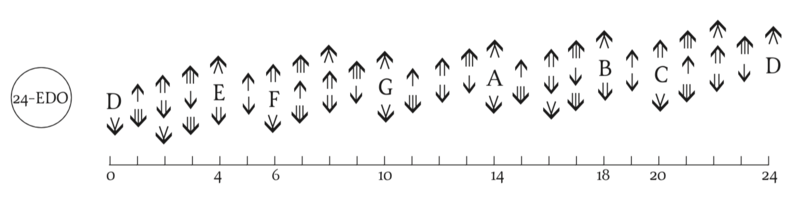
In Western music the octave is traditionally split into twelve equal steps, each 100 cents wide. 24‑tone equal temperament, or 24TET, doubles that resolution, carving the octave into twenty‑four steps of exactly 50 cents each. In practical terms, every pitch sits halfway between two standard semitones, creating a built‑in quarter‑tone grid that works the same way across the entire pitch spectrum.
This uniform division means that, unlike just‑intonation or historical temperaments, every interval in 24TET maintains the same size wherever it appears. The system therefore preserves the mathematical consistency of 12TET while offering a much finer tonal palette.
Why Musicians Turn to 24TET
Quarter‑tone music has been part of folk traditions for centuries, but modern composers and producers gravitate toward 24TET because it lets them explore those shades without the hassle of retuning for each key. The system’s symmetrical nature makes modulation seamless—move up a minor third in 12TET, and you’ll find a clean‑sounding equivalent in 24TET that lands exactly on a quarter‑tone step.
Artists seeking “in‑between” colors—those that feel neither fully major nor fully minor—often describe the effect as a “blurred” emotional tone. That ambiguity can add tension, exotic flavor, or a sense of floating time, which is why 24TET shows up in contemporary jazz, experimental electronic, and even film scores that aim for an unsettling atmosphere.
How 24TET Is Built
The math behind the system is straightforward: an octave spans a frequency ratio of 2:1. Divide the logarithmic distance by 24, and each step raises the pitch by the 24th root of 2 (≈1.0293). In cents, that’s a clean 50‑cent increment—exactly half of a standard semitone.
Because the steps are equal, any interval can be expressed simply by counting steps. A perfect fifth, for example, becomes 14 steps (700 cents) instead of the familiar 7 steps in 12TET. A major third stretches to 8 steps (400 cents), while a traditional minor third shrinks to 6 steps (300 cents). The extra granularity also yields “neutral” intervals—like a neutral second (150 cents) that sits between a minor and a major second.
Practical Uses and Notable Works
Several classical composers experimented with 24TET long before digital tools made it easy. Czech composer Alois Hába wrote a series of quarter‑tone string quartets in the 1920s, and Russian pianist‑composer Ivan Wyschnegradsky published a set of “Ultrachromatic” etudes that rely on the 24‑step lattice.
In the 21st century, microtonal pioneers such as Jacob Collier and the electronic duo 120 Days use software synths that can load a 24TET scale file, allowing them to blend conventional chords with subtle pitch bends that would be impossible in 12TET. Some modern guitars feature extra frets or interchangeable fretboards that physically realize the quarter‑tone steps, giving performers a tactile way to experiment.
- Jazz improvisation: Quarter‑tone bends add a vocal‑like expressivity.
- Film scoring: Ambiguous harmonies heighten suspense without sounding exotic.
- Electronic production: Synthesizers can map each of the 24 steps to a MIDI note, enabling complex arpeggios that glide through micro‑intervals.
Challenges and Tuning Considerations
Adopting 24TET isn’t without hurdles. Traditional acoustic instruments—piano, guitar, wind—are built for twelve‑tone spacing, so players must either modify the instrument or rely on digital emulation. Even with a synthesizer, the ear can struggle to recognize the subtle difference between, say, a 300‑cent minor third and a 350‑cent “neutral” third, especially in fast passages.
Another practical issue is notation. While some scores use a “half‑sharp” ( ♯︎ ) or “half‑flat” ( ♭︎ ) sign to indicate a quarter‑tone alteration, most composers resort to custom symbols or explicit pitch numbers, which can be daunting for performers unfamiliar with microtonal reading.
Finally, tuning stability matters. Because each step is only 50 cents apart, intonation drift of a few cents can make a passage sound noticeably out of tune. Musicians who rely on live acoustic resonances often need a highly accurate reference pitch or a digital tuner that supports 24‑step calibration.
Getting Started with 24TET
If you’re curious about experimenting, the easiest entry point is a software synth that lets you upload a .scl (Scala) file defining a 24‑step equal scale. Load that into a DAW, map the MIDI keyboard to the new layout, and try playing familiar chords—listen for the “quarter‑tone” shimmer that appears on the edges of each interval.
For acoustic players, consider a fretless string instrument or a wind instrument with adjustable reeds. Many modern flutes and saxophones come with “micro‑tuning” mouthpieces that can be fine‑tuned by ear. Even a simple pitch‑bending pedal on an electric guitar can approximate the half‑step offsets when used sparingly.
FAQ
What’s the main difference between 24TET and 12TET?
24TET splits each semitone in half, giving 24 equally spaced notes per octave. This creates quarter‑tone intervals (50 cents) that are impossible in the standard twelve‑tone system.
Can I use 24TET on a regular piano?
Not directly, because a piano’s fixed hammer action is tuned to 12TET. However, digital piano plugins or virtual instruments can simulate 24TET, and some pianists use a “split‑keyboard” approach where the left hand plays in 12TET while the right hand explores quarter‑tone patterns.
Is 24TET suitable for pop music?
It’s uncommon in mainstream pop, but producers sometimes sprinkle quarter‑tone slides or bends to add a fresh timbral twist. The effect works best when the rest of the arrangement stays in a familiar tonal center, letting the micro‑intervals stand out as a decorative detail.
Do I need special software to compose in 24TET?
Most modern DAWs support custom tuning files via plugins like Scala, MTS‑ESP, or built‑in pitch‑mapping tools. Once the scale is loaded, you can write, edit, and playback music just as you would with any other scale.